
Bypass System Upgrade: Enhancing Production Stability and Increasing the Use of Alternative Fuels
The reconstruction of the kiln line bypass system is one of CEMMAC's most significant recent investment projects. The upgrade has increased the system's capacity to remove volatile compounds, improved production stability, and created the conditions for a substantially higher use of alternative fuels. As a result, the project enhances operational reliability while reducing the environmental impact of cement production.
Although the original bypass system had operated reliably for many years, its technical capacity no longer met current production requirements. The size of the cooling chamber, fans, ductwork, and filter allowed only approximately 7–8% of the kiln gases to be extracted, creating a significant technological limitation.
Today, the cement industry is increasingly replacing traditional fossil fuels, particularly pulverised coal, with solid recovered fuels (SRF) and other alternative fuels. These fuels are produced from processed municipal and industrial waste, biomass, and waste plastics. Their use offers significant environmental and economic benefits but also increases the concentration of chlorine and other volatile compounds within the production process.
These compounds promote the formation of buildups in the preheater, which can adversely affect production stability. The primary objective of the reconstruction was therefore to increase the bypass capacity, enabling more efficient removal of volatile substances from the kiln system. The upgraded bypass now makes it possible for alternative fuels to supply up to 95% of the thermal energy required for clinker production.
Thorough Project Preparation
The bypass reconstruction was technically demanding not only because of its scale but also because it was carried out while the cement plant remained in operation.
The engineering design was prepared by CEMEL servis s.r.o. of Přerov, Czech Republic, a company with extensive experience in designing technologies for the cement industry.
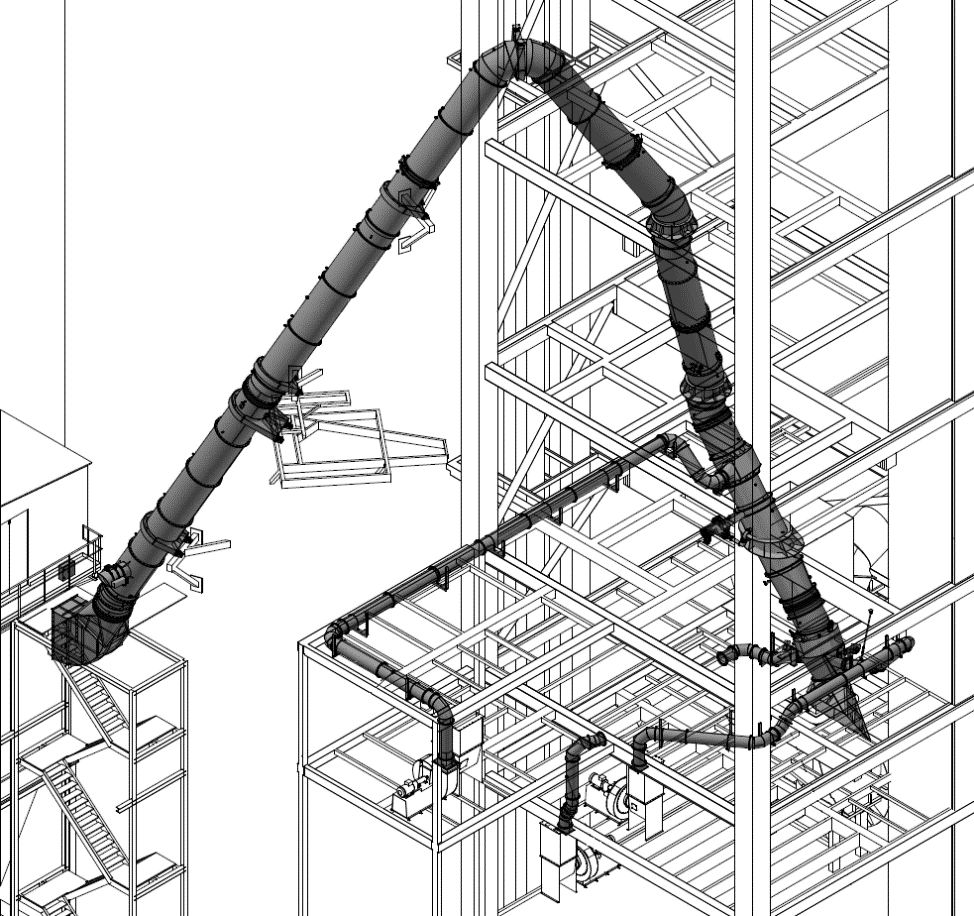
As part of the project preparation, the existing installation was captured using 3D laser scanning. This enabled engineers to accurately design the new ductwork and steel structures while minimising the risk of clashes during installation.
Removal of the Existing Equipment and Construction of New Structures
The first phase of the project involved dismantling the original bypass system. This included the removal of the gas cooling chamber, fans, isolation damper, gas ducts, gas conditioning unit, bypass filter, bypass fan, dust conveyors, and selected steel support structures.
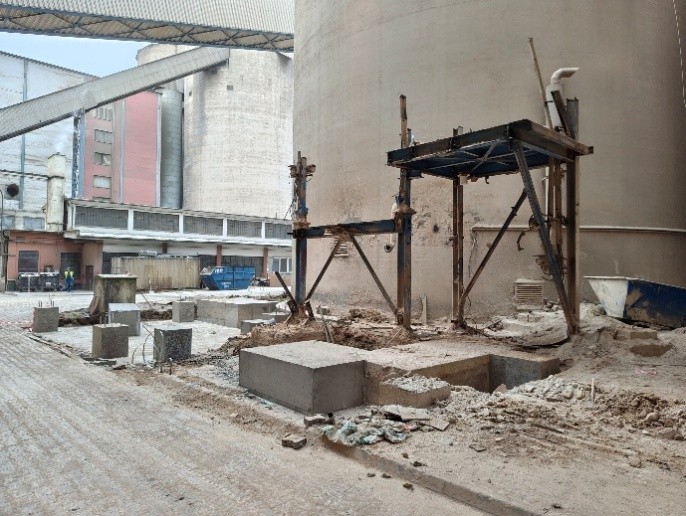
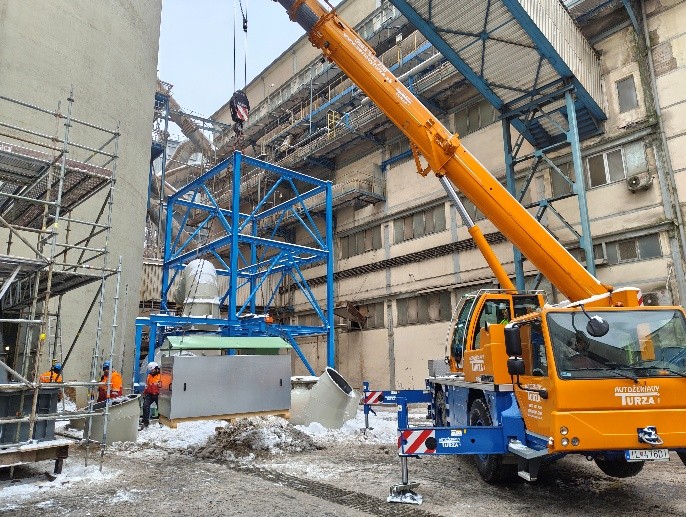
The new system required the construction of several steel structures designed to safely support the new equipment, withstand dynamic loads, and provide convenient access for operation and maintenance. The project also included a dedicated staircase and maintenance platforms around the filter installation.
Extensive civil engineering works were carried out as well, including new reinforced concrete foundations for the filter, bypass fan, dust transport pump, staircase supports, and pipeline structures.
New Cooling Chamber and Gas Duct System
One of the most important components of the upgraded bypass is the enlarged gas cooling chamber, located on the side of the kiln inlet section. Its purpose is to rapidly cool the gases extracted from the kiln system.
The gases entering the chamber reach temperatures of approximately 1,150°C. Cooling therefore takes place in two stages. During the first stage, the temperature is reduced to around 320°C, followed by a second stage that lowers it further to approximately 220°C. At this point, the gases can safely enter the filtration system.
Before reaching the filter, kiln dust is introduced into the ductwork and mixed with the bypass dust. This reduces the chlorine concentration in the final material and enables its safe pneumatic transport.
Bag Filter and Bypass Fan – The Heart of the System
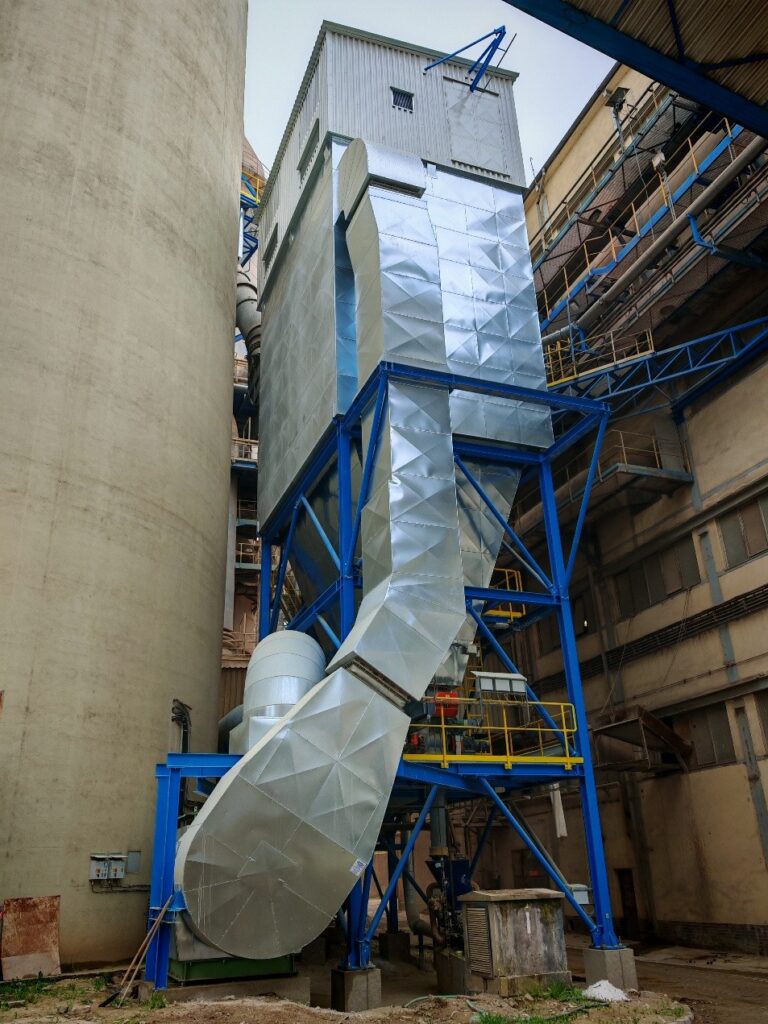
After cooling, the gases enter the bypass bag filter, which is installed on a separate steel structure adjacent to the homogenisation silo. Its purpose is to remove solid dust particles from the gas stream.
The gases enter the filter at approximately 185°C, an ideal temperature for dry filtration. The bag filter uses textile filter bags that capture dust particles on their surface. The resulting dust layer further improves filtration efficiency, allowing even very fine particles to be separated effectively.
The gases enter the filter at approximately 185°C, an ideal temperature for dry filtration. The bag filter uses textile filter bags that capture dust particles on their surface. The resulting dust layer further improves filtration efficiency, allowing even very fine particles to be separated effectively.
Collected dust is stored in a hopper equipped with level sensors and heating elements that prevent moisture condensation during kiln start-up. The material is then discharged through a reversible screw conveyor with two outlets, each fitted with a shut-off valve and rotary feeder.
After filtration, the cleaned gases pass through the bypass fan, which maintains the negative pressure required throughout the entire system. The fan can rightly be described as the heart of the bypass installation, ensuring continuous extraction of kiln gases and their return to the production process through the return duct.
Environmental Benefits
Improving the environmental performance of production was one of the key drivers behind the project.
The increased bypass capacity enables more efficient removal of chlorine and other volatile compounds from the kiln system. This allows a significantly higher proportion of alternative fuels to be used without compromising production stability.
The result is lower fossil fuel consumption, a reduced carbon footprint, and more efficient utilisation of waste as an energy source.
The new filtration system also contributes to improved air quality by reducing particulate emissions.
Results of the Upgrade
The reconstruction has delivered a number of measurable benefits, including:
-increased bypass capacity;
-improved kiln stability;
-reduced buildup formation in the preheater;
-fewer unplanned shutdowns;
-a significantly higher share of alternative fuels;
-improved environmental performance.
The project represents another important step towards more efficient, reliable, and environmentally responsible cement production.
Investing in the Future
The bypass reconstruction demonstrates how upgrading a single technological unit can significantly improve the performance of an entire production system. The project has enhanced operational reliability, expanded opportunities for using alternative fuels, and reduced the environmental impact of cement manufacturing.
The new bypass system is therefore far more than a technical upgrade—it is an investment in a more sustainable, efficient, and future-ready cement production process.
Kvalita a inovácie sú našou hlavnou prioritou